No joke, says Yukon government paleontologist Grant Zazula.
"Yukon has a long and storied history with camel fossils," he said.
Paleontologists and Klondike miners have been digging them out of the Northern permafrost for decades — though not often.
Ice-age camel bones, found in Yukon, rearrange camel family tree
"They're incredibly rare. I think there's about 50 bones known that have ever been found in Alaska or Yukon, and that's in comparison to the tens of thousands of ice-age woolly mammoths and bison and horses," Zazula said.
Western camel An ice-age western camel. The species is believed to have migrated into Yukon and Alaska about 100,000 years ago. (Submitted by Government of Yukon)
The new skeletons (not real bones, but rather replicas cast from an actual, complete skeleton found in California) will be purchased by the Department of Tourism and Culture to help Zazula and others identify any new bone or fossil finds.
"We need other skeletons so when we find bones, we can kind of match them up.
"We have a comparative collection of things like moose and bison and Saiga antelope, but we don't have a good comparison of what a true ancient camel looks like."
A 'strange and fascinating' story
Radiocarbon dating suggests camels — once prevalent in North America — only migrated into Alaska and Yukon during a brief period about 100,000 years ago, when temperatures were warmer than usual. Few camels made the trip North.
Grant Zazula
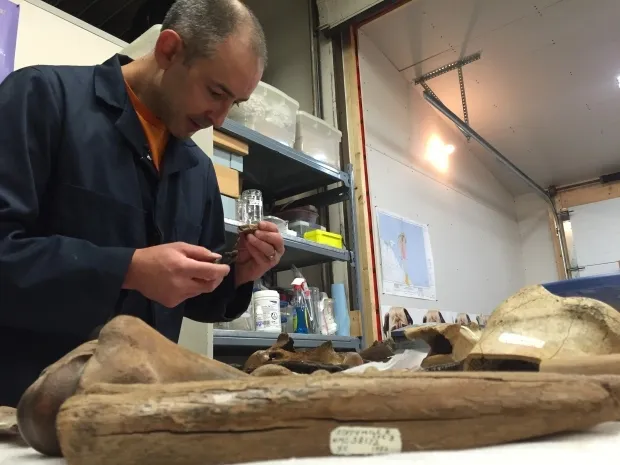
Yukon paleontologist Grant Zazula is radiocarbon dating all the camel bones ever found in Yukon and Alaska, 'to actually start pin-pointing the story of when camels lived here, and for how long they lived here and why they are no longer here.' (Philippe Morin/CBC)
"Camels are at the top of my wish list for ancient fossils right now," said Zazula, who spends every summer digging in the Klondike region. "When we find them it's like Christmas, we are so excited."
The government is buying two skeletons so that one can be used for paleontological research and the other can form an exhibit somewhere in the territory.
Zazula says many people are surprised to learn camels once roamed the Yukon, so he makes no bones about it — it's time to share the "strange and fascinating" story.
"There's not a better way to do that than to get a skeleton out on display somewhere."