The First People of the Yukon
The exact time when Indigenous people first arrived in the Yukon, and the specific paths they took, are still debated. However, evidence from DNA, archaeology, language studies, and geology all show that Beringia, a large land bridge of the past, played a role in the early history of Indigenous peoples in the Western Hemisphere.
Beringia first emerged when much of the Earth’s water was trapped in massive glaciers. This lowered sea levels and created a dry, cold grassland know as the mammoth steppe biome that stretched from modern-day Spain, across Eurasia into Siberia, and over to Alaska and the Yukon.
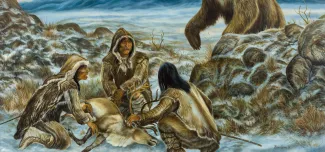
Over thousands of years, glaciers expanded and shrank, shaping valleys and landscapes, and influencing local climates. Many large animals—such as mammoths, steppe bison, and horses—migrated back and forth across Beringia. Archaeological evidence, including stone tools and burned bones, show small groups of humans followed these animals into eastern Siberia by about 45,000 years ago.
To survive in the subarctic and Arctic, early humans needed advanced skills: effective hunting tools, warm clothing, sturdy shelters, and reliable sources of nutrients year-round. Crossing from Siberia into Alaska and the Yukon was not a single journey, but a process of developing and maintaining survival skills over many generations. Adding to this, parts of Beringia would have become impassable at times due to water and glaciers trapping groups of animals and people or forcing them to turn back. Human survival in this environment required great mobility and was likely multi-directional. Despite these challenges, some groups eventually crossed into North America using this route. When the glaciers retreated and melted, the Beringian landscape was flooded, forming what we now know as the Bering Sea.
Archaeological Sites in Yukon Beringia
Archaeological evidence in Eastern Beringia is limited, but the sites that do exist suggest early hunters chose high ground (terraces and knolls) overlooking unglaciated river valleys. These locations offered good views of animals moving across the vast landscape of grass and shrub. Early hunters likely relied on strong social networks and communication between small widely dispersed groups, helping them become widespread across North America by the end of the Pleistocene (around 11,700 years ago).
Little John Site
The Little John Site, located on the traditional territory of the White River First Nation near the Yukon-Alaska border and overlooking the Tanana River drainage, is a prehistoric campsite dating back roughly 14,000 years. Archaeologists have found a variety of stone tools in the site’s oldest sediment layers, including distinctive tear-drop-shaped “Chindadn” projectile points. Well-preserved animal remains show early hunters in the area enjoyed a diverse diet, with the butchered remains of ice age steppe bison, caribou, and elk found alongside bones of wolf, hare, and swan. This site is located at the edge of the Mirror Creek glacial advance and appears related to other late ice-age camps along Alaska’s Tanana River valley.
Britannia Creek Site
The Britannia Creek site, located on the traditional territories of the Selkirk First Nation, the White River First Nation, and the Tr’ondek Hwech’in First Nation in the central Yukon, also dates back about 14,000 years. Bones from bear, wolf, hare, sheep and caribou were found in the oldest soil layers, along with a broken spear point, indicating this site served as an ice-age hunting lookout in the upper Yukon River valley. This site’s upper layers contained obsidian that originated near the Koyukuk River in Alaska, indicating trade connections to the Batza Tena area between Fairbanks and Nome.
Bluefish Caves
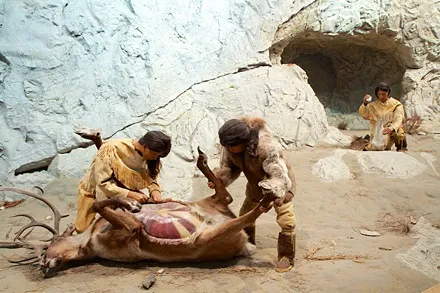
The Bluefish Caves site is perhaps the most famous Eastern Beringian archaeological site to date. It is located on the traditional territory of the Vuntut Gwitchin, southwest of Old Crow, overlooking the Bluefish River. Stone tools found at the site indicate early hunters lived in this unglaciated area of the northern Yukon around 14,000 years ago.
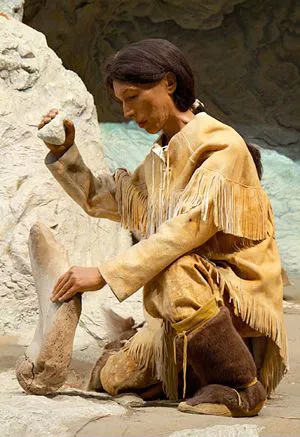
More significantly, there is evidence of much earlier human activity at the site, in the form of butchering and tool manufacture. A horse jaw with cut-mark incisions, a worked mammoth long bone, and a cutting tool made from the same bone have been radiocarbon-dated to 24,800 years ago. Although these early dates have been debated over the past 50 years, recent work has confirmed additional evidence of cut-marked bones with similar ages. This evidence strengthens the case the Bluefish Caves site is one of the most important archaeological sites in Eastern Beringia.
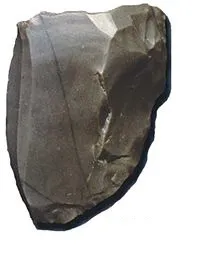
the Bluefish Caves.