 Themed Guided Tours
Interested in how our tours can help support the current learning in your classroom? Here you will find a general outline of what to expect from our tours, as well as grade-level curriculum connections you can expect us to cover during your visit. Click for more information.
Prior to your arrival, please familiarize yourself with our Guided School Trips Policy.
 Classic Programs
Depending on the age of your class, we have some options to enhance your visit and allow students to engage directly with Beringia-related content. These activities are usually conducted following your class's themed guided tour, and are weather and season dependent.
Science Stations
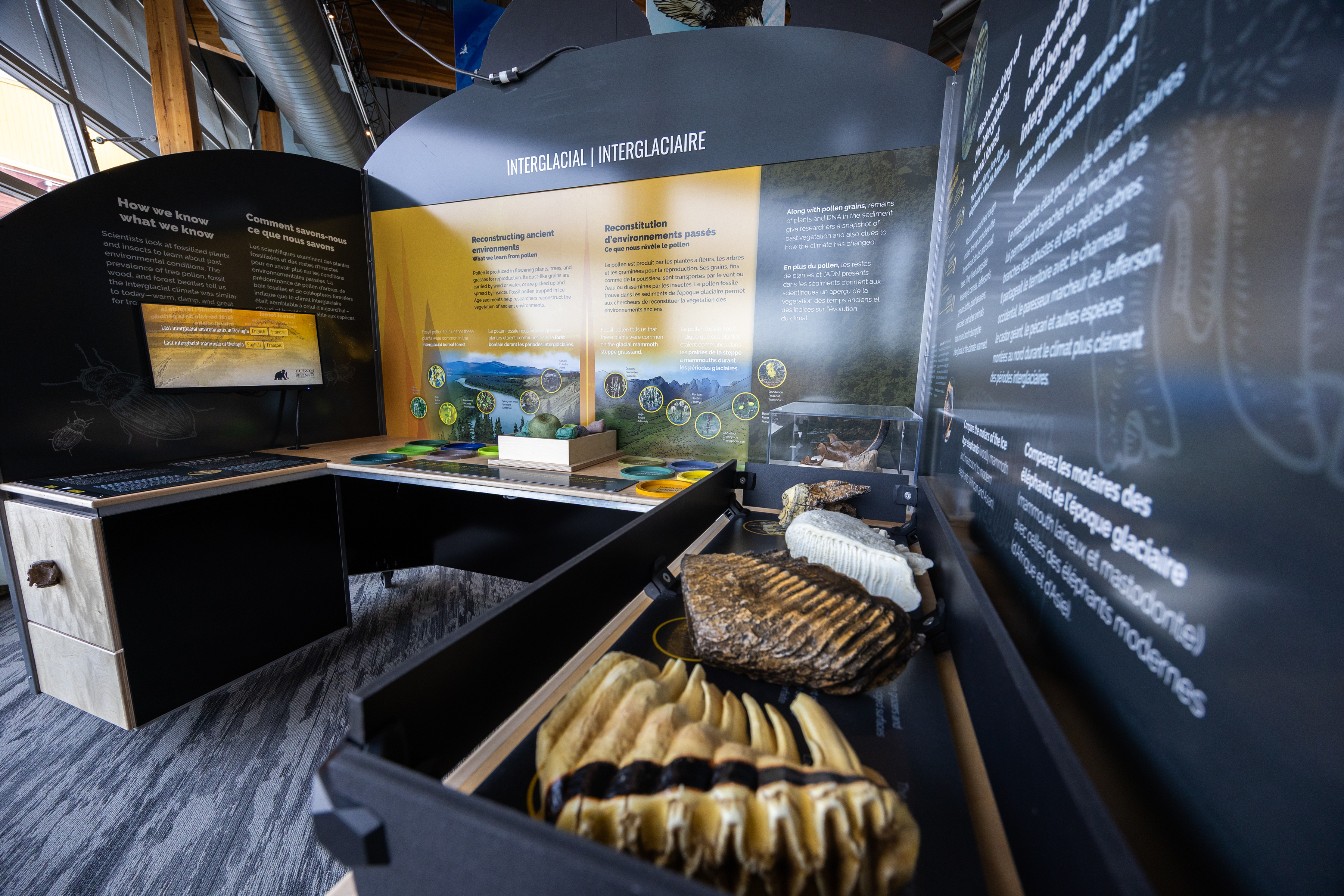 In our renovated front hall, we have three science stations. These align with the mural across the hall, and allow visitors to extend their knowledge surrounding not only Beringian topics, but also the science behind what we know: How can volcanic ash help us date ice age remains? What plant species were around during the ice age? How can something as small as a pollen grain tell such a big story? These are just a few questions that can be answered by exploring our science stations:
- Early Ice Age: Tephra and Yukon Horses
Tephra is a general term for anything that is spewed out of a volcano - ranging from large rocks to small, fine ash. Our first science station explores some commonly-known ash from a variety of Beringian volcanic events, as well as a direct link between dating tephra and dating ice age fossils.
- Last Interglacial: Browsers and Pollen
During the last interglacial, the Yukon looked and felt quite similar to what we see today. At our second science station, discover how preserved pollen grains inform us about past environments. from the past. Also, learn about the browsing (tree-eating) species that traveled north when the glaciers receded.
- Last Glacial: Grazers and Ground Squirrels
Arctic ground squirrels are among the longest-surviving ice age species still common today. Known for frequenting the grassy sides of Yukon highways, these critters have become associated with ice age botany through their collect-and-cache lifestyle preserved in the permafrost. Visit our third science station to explore how arctic ground squirrels left behind clues about what the ancient environment looked like. Also, discover more about the grazing (grass-eating) animals that lived on these grasslands, and how their dentition (teeth) compares to other animals.